




Concerto 2026 Annual General Meeting - São Paulo
A Few Words From Your São Paulo Hosts
Arriving at São Paulo Airport
A Few Basics About São Paulo
Moving Around the City
Food, Drinks and Nightlife
Listening to São Paulo
Safety: The Practical Part
Final Thought
A Few Words From Your São Paulo Hosts


Welcome to São Paulo.
This short guide was prepared by the lawyers of Polli Rodrigues Sluiuzas Advogados for our friends and colleagues from the Concerto network attending the 2026 Annual General Meeting in our city.
You will find below a few practical notes on arriving at the airport, moving around, eating, drinking, listening to music and, perhaps most importantly, keeping your phone in your pocket when São Paulo politely suggests that you should.
This is not meant to replace proper travel guides, Google searches, hotel concierges or the excellent advice of people who are professionally paid to know these things. These are simply local tips from people who live and work here — in other words, a collection of ideas produced by a group of lawyers somewhere between drafting a contract, attending a hearing and wondering whether there is still coffee in the meeting room.
The illustrations on this page were generated by artificial intelligence. None of us had the necessary artistic skill to draw them properly. We do, however, solemnly assure you that they were reviewed by genuine São Paulo residents — including the image of the chicken coxinha, a matter we take extremely seriously.
São Paulo is enormous, intense, multicultural, full of contradictions and probably less dangerous than many visitors imagine, provided that a few basic precautions are taken. We hope these notes help you enjoy your visit to our city, so that it becomes more than just a business meeting.
Arriving at São Paulo Airport
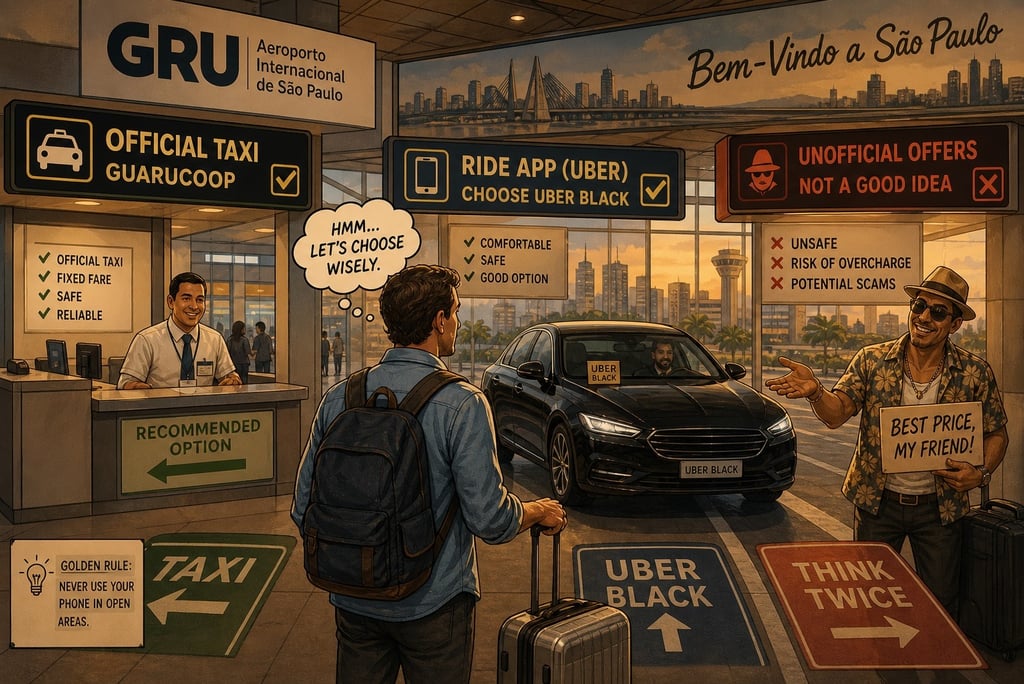
You will most likely arrive in São Paulo through Guarulhos International Airport, usually known as GRU. Despite its name and function, it is not technically in the city of São Paulo, but in the neighbouring city of Guarulhos, within the same metropolitan area. This is very São Paulo: even arriving here is already slightly bigger and more complicated than expected.
You can get from the airport to your hotel by taxi, app-based car or train.
For first-time visitors, the easiest and most comfortable option is usually a taxi. Look for the Guarucoop counter at the airport. Guarucoop is the official local taxi cooperative operating at GRU. The journey to the Paulista/Jardins area will usually cost something in the region of BRL 200 and may take anywhere from one to two hours, depending on traffic, weather, destiny and the mysterious will of São Paulo’s road system.
You may also call an Uber from your phone. If you do, please make sure that the car and driver are exactly the ones shown in the app before getting in. We would not recommend saving a small amount by choosing the cheapest category. In São Paulo, comfort, predictability and safety are worth more than the difference. When using Uber, we suggest choosing Uber Black.
What you should not do, under any circumstances, is accept offers from people approaching you inside the airport terminal claiming to be taxi drivers, private drivers or “basically Uber, but better”. You are unlikely to wake up in a bathtub full of ice missing a kidney. That would be dramatic, and São Paulo is many things, but not usually that cinematic. You are, however, quite likely to be overcharged in a very irritating and unnecessary way.
In theory, you could take the train from the airport to the city centre, as one might do in several European cities. It is not a bad option in itself. The problem is that the arrival area in central São Paulo may not be the most comfortable or intuitive place for a foreign visitor carrying luggage and trying to understand what just happened to the concept of urban planning.
And this is a good moment to introduce the golden rule of São Paulo survival: do not use your phone in open public areas. This includes the outside of the airport terminal, pavements, street corners, outside bars and restaurants, and even neighbourhoods that are generally considered safe. Your phone should be treated like a small, expensive bird: lovely, useful, and best kept safely inside.
A Few Basics About São Paulo
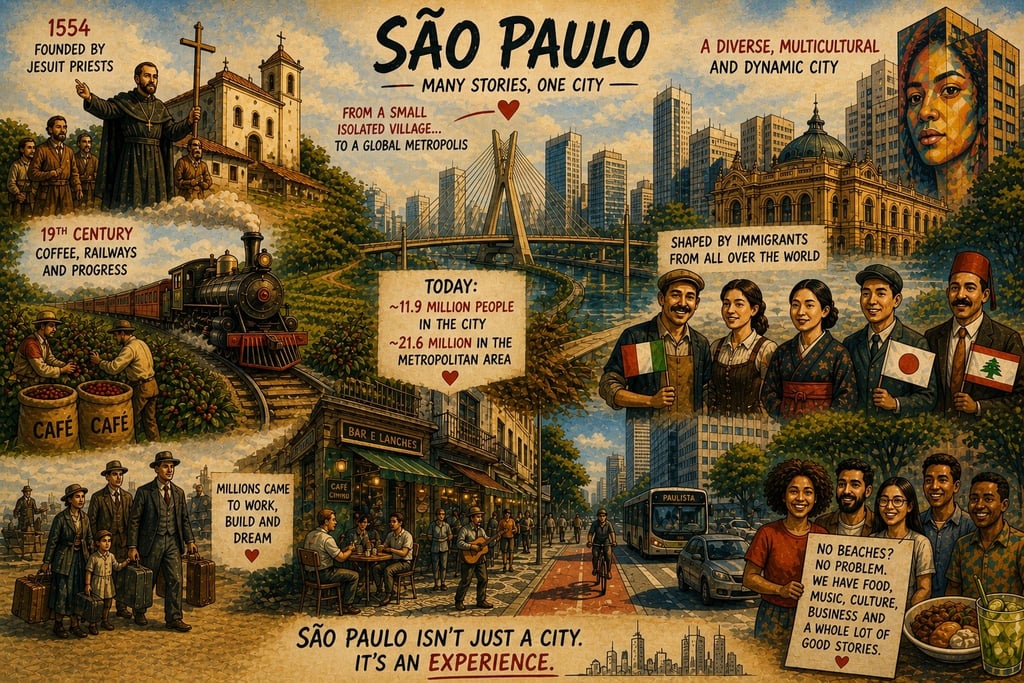
São Paulo was founded by Jesuit priests in 1554. For a long time, it remained a small, isolated and rather poor settlement, partly because it was separated from the coast by the Serra do Mar, a steep mountain range that made access difficult.
Its great transformation came much later, driven mainly by coffee production in the interior of the state, the expansion of railways, the accumulation of wealth and, eventually, industrialisation. Millions of immigrants came to São Paulo from Europe, Asia and the Middle East, while many Brazilians from other regions, especially the Northeast, also moved here in search of work and opportunity.
Today, the municipality of São Paulo has roughly 12 million inhabitants, while the broader metropolitan area has more than 21 million. It is one of the largest urban areas in the world and, depending on the time of day, can feel as if all 21 million people have decided to stand between you and dinner.
São Paulo has no beaches, no mountains in the middle of the city and no obvious postcard landscape of the Rio de Janeiro variety. Its appeal lies elsewhere: food, culture, business, immigration, nightlife, art, shopping, music, medicine, architecture, chaos and the strange pleasure of discovering beauty in a place that does not always make it easy.
Moving Around the City
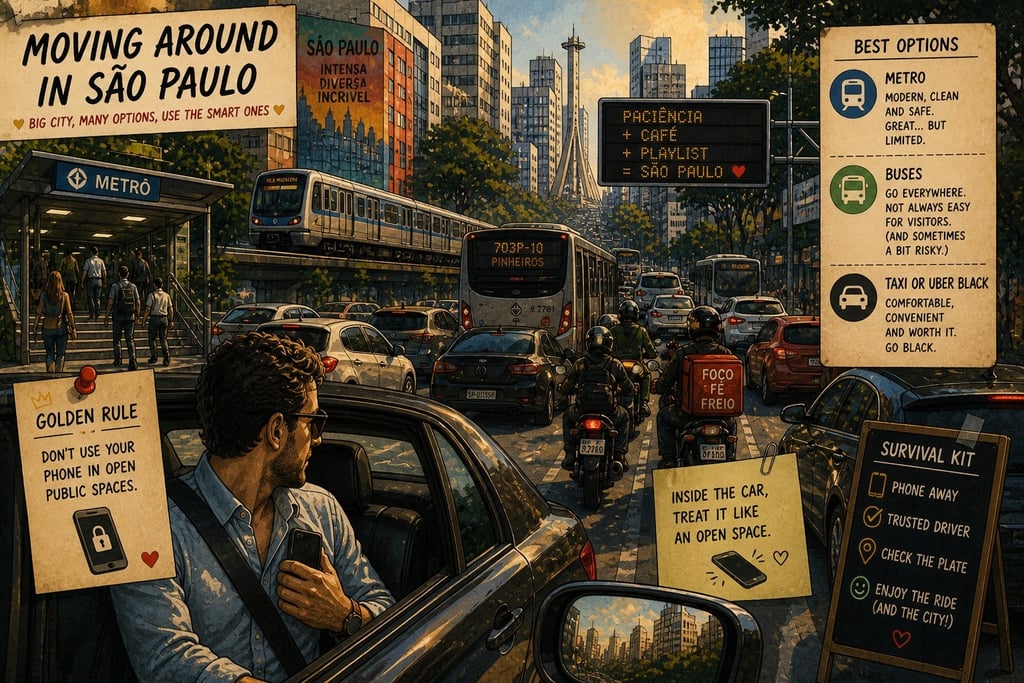
São Paulo’s metro is generally modern, clean and safe. Many stations are well organised, and the system is a source of local pride. The problem is that the network is much smaller than a city of this size would require. It may help you for certain routes, but it will not always take you where you want to go.
Most public transport in São Paulo is carried by buses, which reach parts of the city even many lifelong residents have never seen. However, buses are not particularly easy for visitors who do not speak Portuguese, and they are not the most comfortable option if you are unfamiliar with the city.
For visitors, the simplest way to move around is usually by taxi or Uber, preferably Uber Black. It is not excessively expensive by European standards, and the convenience and safety usually justify the choice. São Paulo is a car-oriented city, for better or worse — mostly worse, but let us be gracious hosts — and in most cases the driver will be able to drop you very close to your destination.
While inside a taxi or Uber, avoid using your phone in a way that is clearly visible from outside the car, especially when the vehicle is stopped in traffic. There has been a wave of thefts in which criminals break car windows, grab phones from passengers and escape quickly on motorcycles between the cars. For the purposes of our golden rule, please treat a taxi or Uber as a semi-open space. São Paulo is a city of legal fictions; this one is practical.
Food, Drinks and Nightlife
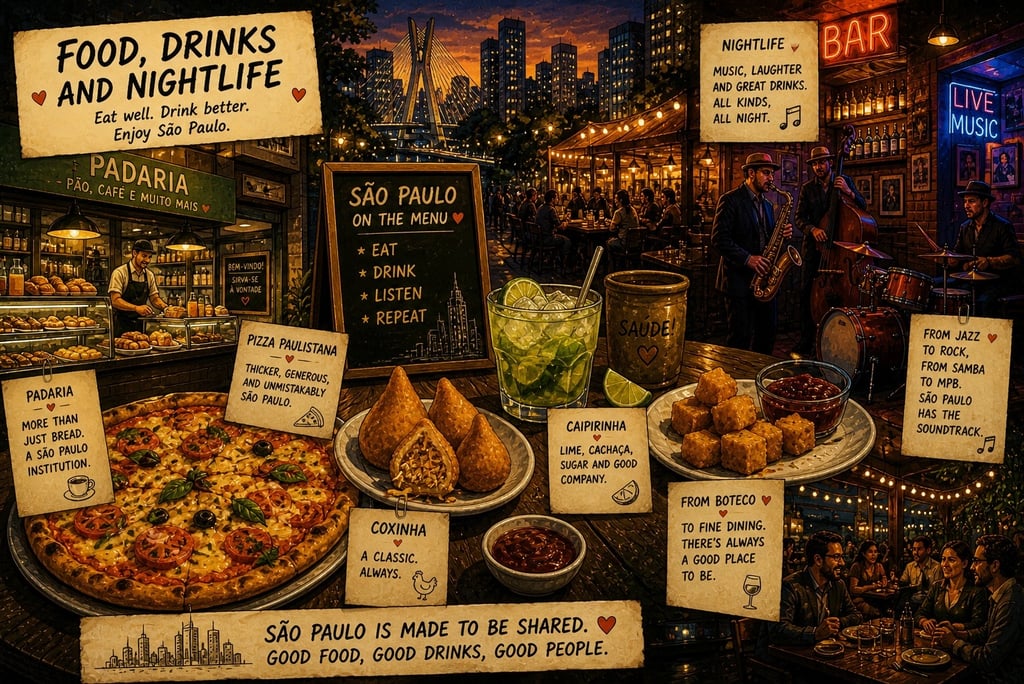
São Paulo is an excellent city for eating, drinking and going out. You will find food from many parts of the world, often prepared by immigrants or their descendants, at times of day when several European cities would already have emotionally closed for the night.
It may sound strange to suggest that you try pizza in Brazil, but please trust us on this. São Paulo pizza belongs to the same family as its European relatives, but it has developed its own personality. It is generous, serious, sometimes excessive and deeply loved by the local population. Trying it is part of the São Paulo experience. For good examples, we suggest Bráz, Veridiana and 1900.
In bars and casual restaurants, you should also try two classic snacks: coxinha de frango and dadinho de tapioca with chilli jam. Coxinha is a teardrop-shaped fried dough filled with shredded chicken. Dadinho de tapioca is a small fried cube made with tapioca and cheese, usually served with a sweet-and-spicy sauce. Both are examples of what we call comida de boteco — Brazilian bar food. They are not especially healthy. This is not the section about health.
If you drink alcohol, you should not leave São Paulo without trying a caipirinha. Avoid, at least for your first one, the versions made with vodka, sake or exotic fruit combinations. The classic caipirinha is made with lime, sugar and cachaça. It is simple, bright, dangerous in a friendly way and should be treated with the same respect you would give to a charming witness who may destroy your case.
A good bar with a pleasant atmosphere and well-made drinks is Astor. There is a branch relatively close to the Renaissance Hotel, where the Concerto AGM will take place. There is also a very interesting branch inside the vault of the former Banespa bank building in central São Paulo. It can be a good daytime or weekend option, but the surrounding area is not ideal at night.
A true São Paulo experience also requires a visit to a bakery. Please do not imagine a modest place that merely sells bread. A São Paulo padaria may sell bread, coffee, sandwiches, juices, pastries, cakes, snacks, meals, soup, beer and possibly the answer to several existential questions. To experience this without wandering too far, you may try Bella Paulista, close to the Renaissance Hotel, or Galeria dos Pães.
If you want to try more sophisticated contemporary Brazilian cuisine, restaurants such as D.O.M., Maní, A Casa do Porco, Tuju or Corrutela may be worth considering, depending on availability, style and budget. Some of these have appeared in the Michelin Guide in different categories, and all are part of São Paulo’s more ambitious restaurant scene. They are not places most of us visit casually on a Tuesday after work, unless the Tuesday has gone exceptionally well. Another excellent option is Vista, but we will already go there for our closing dinner.
São Paulo’s nightlife is as varied as its population. For drinks and live music, we particularly like places such as The Blue Pub and Blue Note. Their names are similar, but they are not connected. The first is more rock-oriented; the second is focused on jazz and related styles. Both are well located, have interesting programmes and tend to work well for both locals and visitors.
If you would like to hear more recognisably Brazilian music, you may sometimes find it at Blue Note. Other options include Ó do Borogodó and Bar Brahma Centro. Ó do Borogodó is in a more bohemian area, which may not appeal to everyone, but it is a respected and authentic music venue. Bar Brahma Centro is historically important and can be very enjoyable, but the surrounding area is degraded and not particularly safe. If you go, arrive by Uber at the door and leave by Uber from the door. This is not the moment for spontaneous urban exploration.
Listening to São Paulo
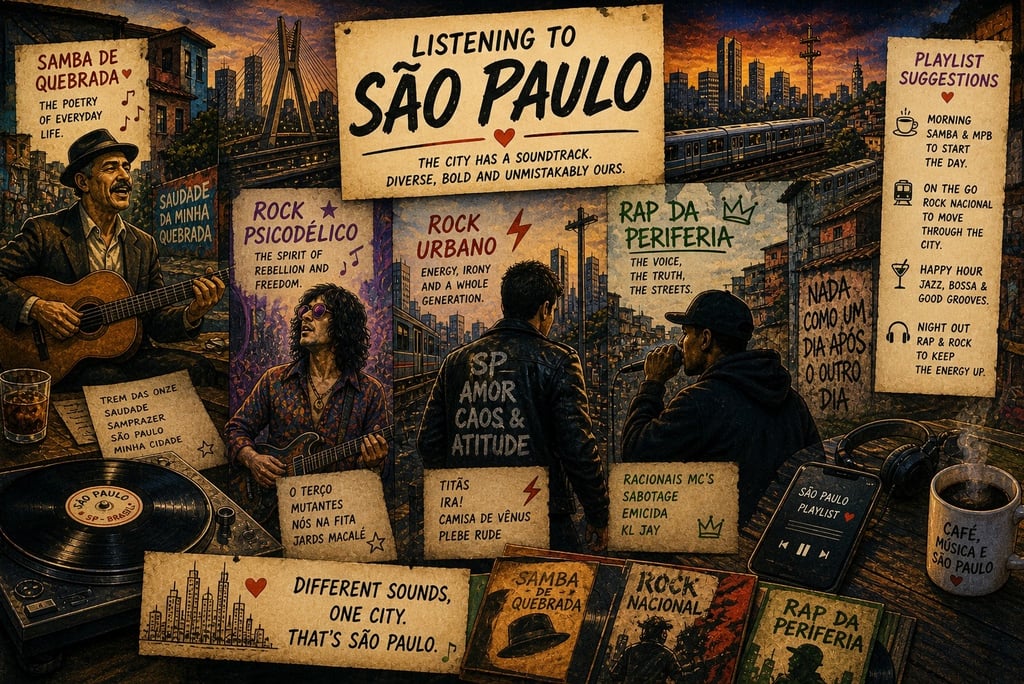
One way to understand São Paulo before even landing is through its music. Not Brazilian music in general, but music that somehow carries the city’s accent, contradictions and nervous system. We have prepared a Spotify playlist for you.
São Paulo samba is not the same as Rio de Janeiro samba, and it is definitely not the samba-enredo heard during Carnival parades. The city has its own tradition, and two essential classics are Samba do Arnesto and Trem das Onze, both by Adoniran Barbosa. They are funny, affectionate, urban and deeply São Paulo.
Caetano Veloso, who was born in Bahia, wrote Sampa about his impressions of São Paulo. For many people, especially migrants who arrived here feeling overwhelmed by the city, it became something like an unofficial anthem. It is one of the great songs about the shock, strangeness and eventual seduction of São Paulo.
One singer captured the spirit of the city particularly well: Rita Lee. Playful, clever, irreverent and cosmopolitan, she represents a São Paulo that is urban, ironic, psychedelic, pop and allergic to solemnity. We suggest Ando Meio Desligado, Ovelha Negra and Agora Só Falta Você.
In the same São Paulo rock universe, Titãs are essential. They are sharp, urban, intelligent and sometimes aggressively direct. Good starting points include Sonífera Ilha, Comida and Polícia.
If you want to go deeper and listen to the sound of the city’s outskirts, listen to Racionais MC’s, especially Negro Drama and Diário de um Detento. They are probably the most important voice of São Paulo’s peripheral neighbourhoods in Brazilian music. Their rap is social testimony, street literature and political chronicle, dealing with inequality, racism, police violence and everyday survival with extraordinary force.
Safety: The Practical Part
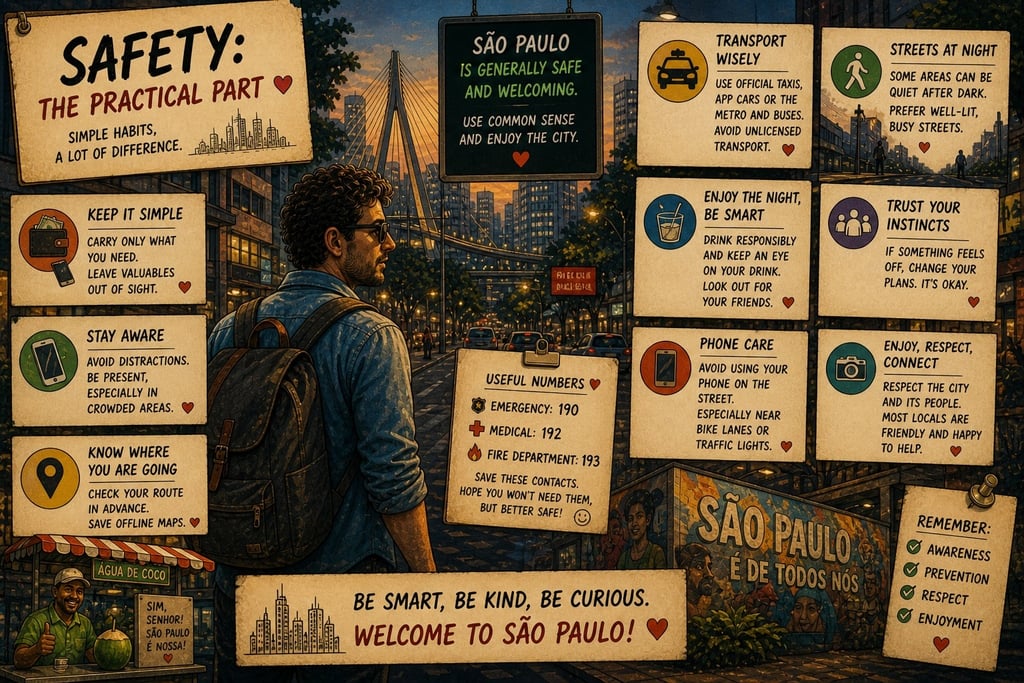

São Paulo is a very large and heterogeneous city. Safety conditions vary considerably from one neighbourhood to another, and even from one street to the next. In general, you should remain alert and take at least the same precautions you would take in any major city you do not know well.
As a rough comparison, São Paulo’s homicide rate is much lower than many foreign visitors expect and is closer to that of some large North American cities than to the stereotype often associated with Brazil. That said, it is still significantly higher than in most European capitals. The main risk for visitors in central and wealthier areas of São Paulo is not violent crime in the dramatic sense, but theft and robbery, especially of mobile phones, watches and bags.
Because you will not necessarily know which areas are safer and which are not, avoid walking at night unless you are with locals who know exactly where they are going. During the day, keep your phone out of sight when walking on the street. Ideally, keep it in an inside pocket or in a secure bag. Avoid wearing expensive watches, jewellery or accessories that may attract unnecessary attention.
On the street, be aware of common scams found in many large tourist cities. Pickpockets may act while visitors are distracted by a street performance, a game or a sudden commotion. Do not accept “gifts” from strangers, and be cautious with people asking for money for bus tickets, nappies, medicine or similar stories. Some requests may be genuine, but many are part of familiar street scams.
Shopping centres, hotels, restaurants, bars, museums and established entertainment venues are generally safe, but common sense still applies. Do not leave your phone, bag, wallet or laptop unattended. Keep your belongings with you and within sight.
You may use your phone normally inside restaurants, bars, hotels and shopping centres. Just remember the golden rule when stepping outside: do not use your phone on the street. São Paulo will forgive many things. Waving an unlocked smartphone on a pavement is not always one of them.
Final Thought
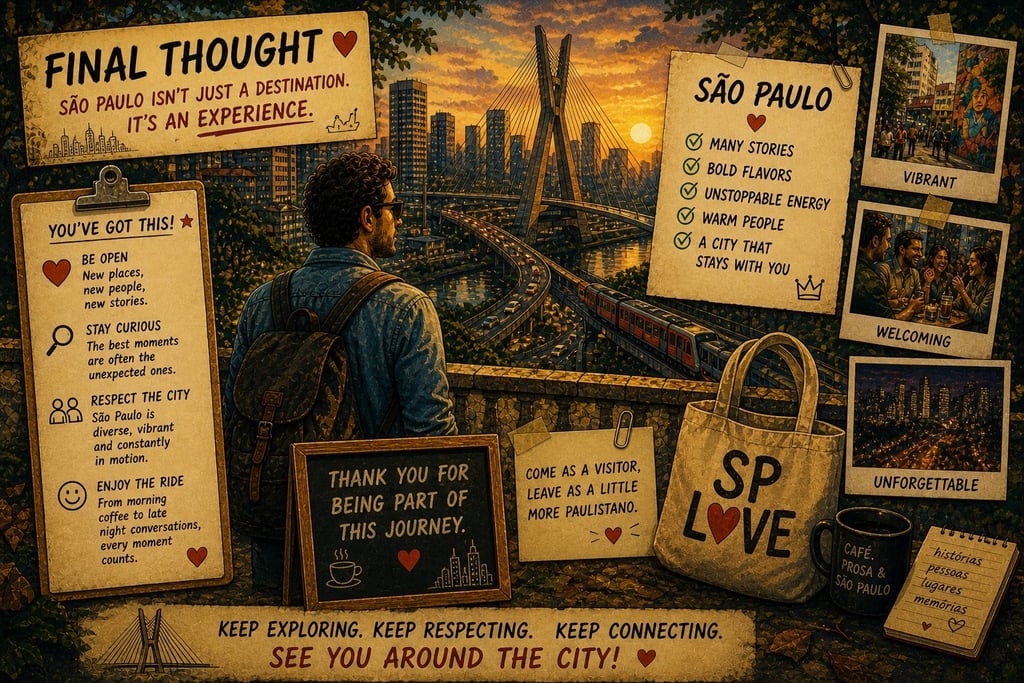

São Paulo is not always love at first sight. It is too large, too fast, too noisy and too contradictory for that. But it rewards curiosity. Behind the traffic, concrete and intensity, there is extraordinary food, music, history, humour, intelligence and warmth.
We are very happy to welcome you here for the 2026 Concerto AGM. We hope you enjoy the meeting, the city and, if all goes well, at least one properly made caipirinha.
Welcome to São Paulo. Keep your phone in your pocket, your appetite open and your sense of humour close at hand.
POLLI RODRIGUES SLUIUZAS ADVOGADOS
+55 (11) 3090-8500
OAB/SP nº 10.597
Avenida Paulista, 1.374, 12º andar, sala A-128
Brazilian Financial Center
01310-916 São Paulo, SP - Brasil
Avenida Queiroz Filho, 1.560, Torre Beija-Flor, sala 104
Vista Verde Offices
05319-000 São Paulo, SP - Brasil
+55 (11) 3284-8110